
Pay as you Go System versus Fully Funded Pension in Peru
DOI:
https://doi.org/10.17230/ecos.2013.36.1Keywords:
Fully Funded, Pay as You Go, SustainabilityAbstract
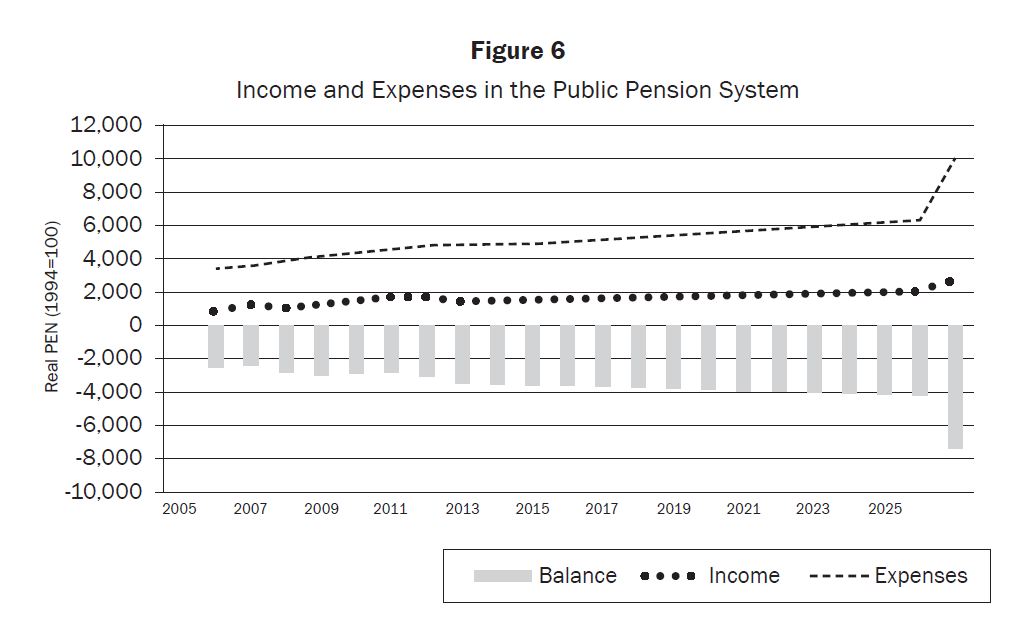
The following paper analyses the sustainability of the Peruvian “Pay as You Go System” which is provided by the Government. In Peru, the “Pay as you Go System” coexists with Private Pension Funds or “Fully Funded Pension”. Sometimes both systems compete with each other with advantages and disadvantages between them. We found that “Pay as You Go System” cannot be sustainable over a long period of time. In addition, based on a comparative analysis of advantages and disadvantages, we propose some recommendations to make Private Pension Funds (Fully Funded Pension) the best alternative to Pay as You Go System.
Downloads
References
Asociación Internacional de Organismos de Supervisión de Fondos de Pensiones (AIOS). Base de Datos de AFPs en Latinoamérica.
Banco Central de Reservadel Perú (BCRP). Memorias y Notas Semanales.
Bernal, N. et al, (2008), "Una mirada al sistema peruano de pensiones: diagnóstico y propuestas". Estudios previsionales del BBVA.
Comisión EconómicaparaAméricaLatinay el Caribe (CEPAL). Datos demográficos de CELADE – División de Población.
Crabbe, Carolin A. (2005) A Quarter Century of Pension Reform in Latin Amereica and the Caribean: Lessons Learned and Next Steps. Washington DC. IDB. 409p
Instituto Nacional de Estadísticae Informática(INEI). Estadísticas y Cuentas Nacionales.
Instituto Nacional de Estadísticae Informática(INEI). Encuesta Nacional de Hogares del 2011.
Kay, Stephen J. & Sinha, Tapen (ed.), 2007. “Lessons from Pension Reform in the Americas,”OUP Catalogue, Oxford University Press, number 9780199226801, March.
Ley 054-97 de Creación del SistemaPrivado de Pensiones Peruano (1997) Texto Unico Ordenado de la Ley del Sistema Privado de Administración de Fondos de Pensiones. Ministerio de Economía y Finanzas.
Ley de Reformade Pensiones 29903 (2012). Comisión Permanente del Congreso de la República del Perú.
Lusardi A., and Mitchell O. (2007) “BabyBoomer retirement security: The roles of planning, financial literacy, and
housing wealth. Volume 54, Issue 1, January 2007, Pages 205–224.
Oficinade Normalización Previsional (ONP). Base de datos del Sistema Nacional de Pensiones.
Piñeira, J., (1991), “El cascabel al gato: la batalla por la reforma previsional”, Editorial Zigzag. Santiago.
Piñeira, J., (1995), "Empowering workers: The Privatization of Social Security in Chile", CATO. Vol. 15, N° 2-3.
Restrepo J., Gutierrez J. (2011) "Valoración de la garantía de pensión en las cuentas de ahorro individual en Colombia", Innovar, vol. 21, No 41, págs. 51-62
Rofman, Rafael et. Al. (2008) “Pension system in Latin America – Concepts and measurements of coverage. Wold Bank. Discussion Paper 0616.
Stiglitz, J. and P. Orszag (1999), “Rethinking Pension Reform: Ten Myths about Social Security Systems”, paper presented at the Conference on “New Ideas About Old Age Security”, 14-15 September, The World Bank, Washington, D. C.
Superintendenciade Bancay Seguros del Perú (SBS). Base de datos del sistema privado de pensiones peruano.
Downloads
Published
Issue
Section
License
Authors who publish with this journal agree to the following terms:
- Authors retain copyright and grant the journal right of first publication with the work simultaneously licensed under a Creative Commons Attribution License that allows others to share the work with an acknowledgment of the work's authorship and initial publication in this journal.
- Authors are able to enter into separate, additional contractual arrangements for the non-exclusive distribution of the journal's published version of the work (e.g., post it to an institutional repository or publish it in a book), with an acknowledgment of its initial publication in this journal.
- Authors are permitted and encouraged to post their work online (e.g., in institutional repositories or on their website) prior to and during the submission process, as it can lead to productive exchanges, as well as earlier and greater citation of published work (See The Effect of Open Access).

