
A fully discrete finite element scheme for the Derrida-Lebowitz-Speer-Spohn equation
DOI:
https://doi.org/10.17230/ingciecia.9.17.5Keywords:
Finite elements, Nonlinear evolution equations, SemiconductorsAbstract
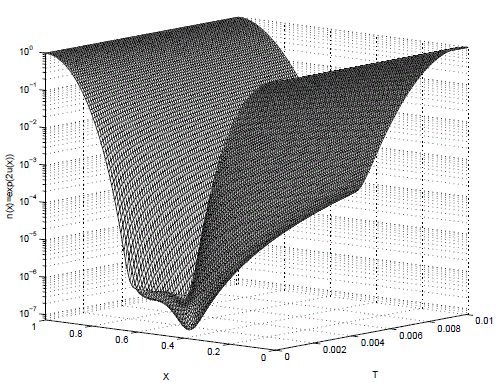
The Derrida-Lebowitz-Speer-Spohn (DLSS) equation is a fourth order in space non-linear evolution equation. This equation arises in the study of interface fluctuations in spin systems and quantum semiconductor modelling. In this paper, we present a positive preserving finite element discrtization for a coupled-equation approach to the DLSS equation. Using the available information about the physical phenomena, we are able to set the corresponding boundary conditions for the coupled system. We prove existence of a global in time discrete solution by fixed point argument. Numerical results illustrate the quantum character of the equation. Finally a test of order of convergence of the proposed discretization scheme is presented.
MSC: 35G25, 65M60, 82D37
Downloads
References
P. M. Bleher, J. L. Lebowitz, and E. R. Speer, “Existence and positivity of solutions of a fourth-order nonlinear PDE describing interface fluctuations,” Communications on Pure and Applied Mathematics, vol. 47, no. 7, pp. 923–942, 1994. 98, 99, 108
B. Derrida, J. L. Lebowitz, E. R. Speer, and H. Spohn, “Fluctuations of a stationary nonequilibrium interface,” Phys. Rev. Lett., vol. 67, pp. 165–168, July 1991. 98
R. Pinnau, “The Linearized Transient Quantum Drift Diffusion Model-Stability of Stationary States,” ZAMM - Journal of Applied Mathematics and Mechanics / Zeitschrift für Angewandte Mathematik und Mechanik, vol. 80, no. 5, pp. 327–344, 2000. 98, 101
L. L. A. Peletier and W. C. Troy, Spatial Patterns: Higher Order Models in Physics and Mechanics. Progress in Nonlinear Differential Equations and Their Applications Series, Boston: Springer, 2001. 99
A. Jüngel and R. Pinnau, “Global Non-Negative Solutions of a Nonlinear Fourth-Order Parabolic Equation for Quantum Systems,” 2000. 99, 100, 108
A. Jüngel and D. Matthes, “The Derrida-Lebowitz-Speer-Spohn equation: Existence, NonUniqueness, and Decay Rates of the Solutions,” SIAM Journal on Mathematical Analysis, vol. 39, no. 6, pp. 1996–2015, 2008. 99
M. J. Cáceres, J. A. Carrillo, and G. Toscani, “Long-Time Behavior for a Nonlinear Fourth-Order Parabolic Equation,” Transactions of the American Mathematical Society, vol. 357, no. 3, pp. 1161–1175, 2005. 99
M. Pia Gualdani, A. Jüngel, and G. Toscani, “A Nonlinear Fourth order Parabolic Equation with Nonhomogeneous Boundary Conditions,” SIAM Journal on Mathematical Analysis, vol. 37, no. 6, pp. 1761–1779, 2006. 99
A. Jüngel and G. Toscani, “Exponential time decay of solutions to a nonlinear fourth-order parabolic equation,” Zeitschrift für angewandte Mathematik und Physik ZAMP, vol. 54, no. 3, pp. 377–386, 2003. 99
B. Düring, D. Matthes, and J. P. Milišić, “A gradient flow scheme for nonlinear fourth order equations,” Discrete and Continuous Dynamical Systems - Series B (DCDS-B), vol. 14, no. 3, pp. 935 – 959, 2010. 99, 108
R. Pinnau, “A note on boundary conditions for quantum hydrodynamic equations,” Applied Mathematics Letters, vol. 12, no. 5, pp. 77–82, 1999. 101
M. G. Ancona and H. F. Tiersten, “Macroscopic physics of the silicon inversion layer,” Phys. Rev. B, vol. 35, pp. 7959–7965, May 1987. 101
E. Zeidler, Nonlinear Functional Analysis and Its Applications II/A. Berlin: Springer-Verlag, 1 ed., 1990. 106
Downloads
Published
Issue
Section
License
Authors who publish with this journal agree to the following terms:
- Authors retain copyright and grant the journal right of first publication with the work simultaneously licensed under a Creative Commons Attribution License that allows others to share the work with an acknowledgement of the work's authorship and initial publication in this journal.
- Authors are able to enter into separate, additional contractual arrangements for the non-exclusive distribution of the journal's published version of the work (e.g., post it to an institutional repository or publish it in a book), with an acknowledgement of its initial publication in this journal.
- Authors are permitted and encouraged to post their work online (e.g., in institutional repositories or on their website) prior to and during the submission process, as it can lead to productive exchanges, as well as earlier and greater citation of published work (See The Effect of Open Access).


 Plagiarism Detection
