
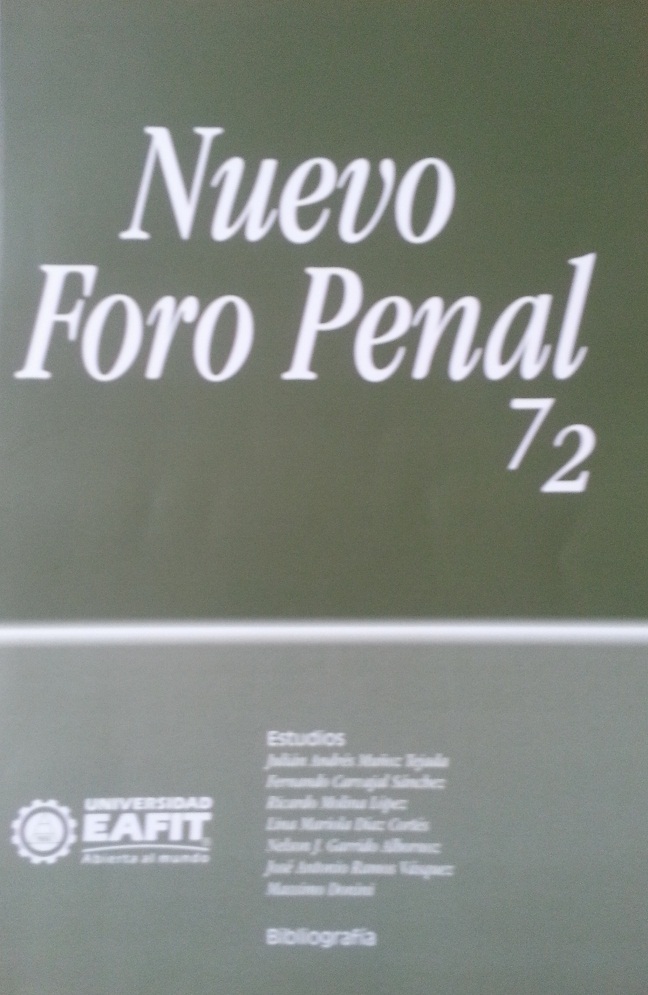
La declaración de inconstitucionalidad del delito del “negacionismo” (artículo 607.2 del código penal español)
Keywords:
Delito de apología, apología del genocidio, delito de opinión, libertad de expresión, provocación al genocidio, derecho penal del enemigoAbstract
Including the crime of “apology for genocide” in the article 607.2 of the Spanish Criminal Code (SCC) was considered a problem by jurisprudence because it was difficult to harmonize that article with the “overall” apology that appears in article 18.1 SCC. The problem was that while the “overall” apology (article 18 SCC) requires, in order to be punished, the action to be considered as a measure tending to the commission of genocide, It seems to be impossible to get this condition in the apology for genocide because of the literal sense of the article 607.2 SCC; so that, the apology for genocide would be a punishment for simple diffusion of ideas and doctrines itself. Accordingly, the crime of apology for genocide would be a sort of crime of opinion, and that can’t be accepted because it means an unjustified limit to the right of expression. Along these lines, declaring unconstitutional a portion of the article 607.2 SCC (the part about negation of genocide) was not enough because that declaration didn’t include the justification of the genocide as unconstitutional, and it was evident that inclusion would be adequate.Downloads
Downloads
Published
Issue
Section
License
Authors who publish with this journal agree to the following terms:
- Authors retain copyright and grant the journal right of first publication with the work simultaneously licensed under aCreative Commons Attribution License that allows others to share the work with an acknowledgement of the work's authorship and initial publication in this journal.
- Authors are able to enter into separate, additional contractual arrangements for the non-exclusive distribution of the journal's published version of the work (e.g., post it to an institutional repository or publish it in a book), with an acknowledgement of its initial publication in this journal.
- Authors are permitted and encouraged to post their work online (e.g., in institutional repositories or on their website) prior to and during the submission process, as it can lead to productive exchanges, as well as earlier and greater citation of published work (See The Effect of Open Access).

