
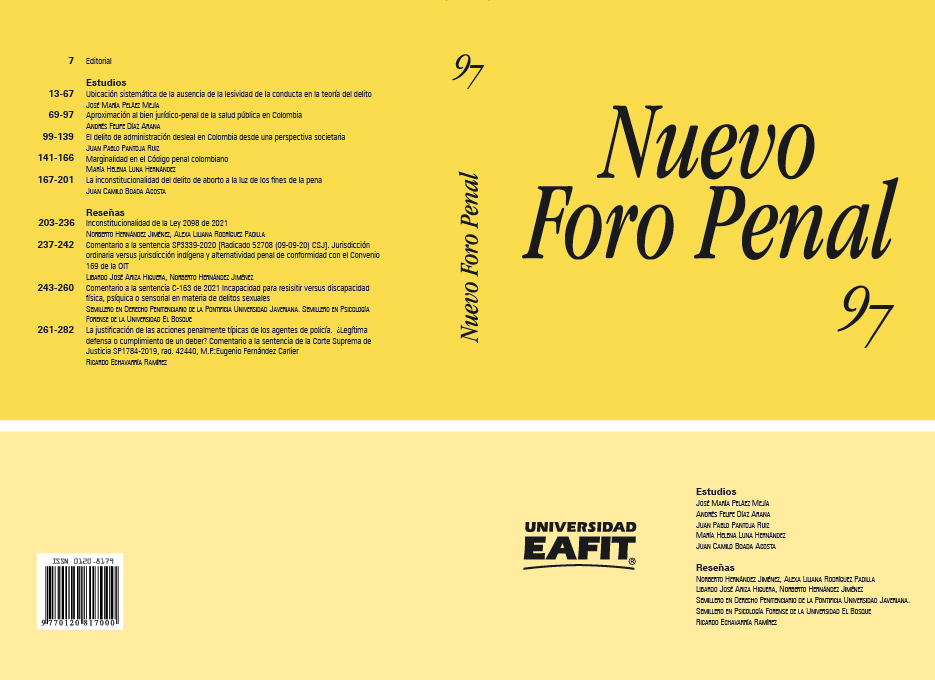
Improper management crime in Colombia. A corporate perspective
DOI:
https://doi.org/10.17230/nfp17.97.3Keywords:
Judgment Rule, criminal law, corporate law, disloyal administration, social action of liability, conflicts of interest, economic criminal law, fiduciary duties, loyalty, abuse of office.Abstract
The offence of disloyal administration, established by Article 250B of the Colombian Penal Code, was created as an instrument to combat corruption in the private sector. The Colombian legislator was inspired by the Spanish legal system to criminalize the act of the administrator who, abusing his or her functions, disposes of company assets or incurs contractual commitments at the company's expense, causing an economically assessable damage. However, to understand when the administrator acts outside his functions and abuses them requires a closer look at company law, which originally regulates the duties of administrators. This paper studies this relationship between criminal law and corporate law to seek to give content to the crime of unfair administration under the theory of the fiduciary duties of the administrator in Colombia. After this, he studies the particularities of the type of unfair administration, pointing out that its wording could be improved, since the promoters of companies in formation were not included, the damage should be predicated on the company and not on its partners, and any administrator who acts for a benefit other than that of the company also abuses the functions of his or her position. Finally, some general conclusions are presented.
Downloads
Downloads
Published
Issue
Section
License
Authors who publish with this journal agree to the following terms:
- Authors retain copyright and grant the journal right of first publication with the work simultaneously licensed under aCreative Commons Attribution License that allows others to share the work with an acknowledgement of the work's authorship and initial publication in this journal.
- Authors are able to enter into separate, additional contractual arrangements for the non-exclusive distribution of the journal's published version of the work (e.g., post it to an institutional repository or publish it in a book), with an acknowledgement of its initial publication in this journal.
- Authors are permitted and encouraged to post their work online (e.g., in institutional repositories or on their website) prior to and during the submission process, as it can lead to productive exchanges, as well as earlier and greater citation of published work (See The Effect of Open Access).

