
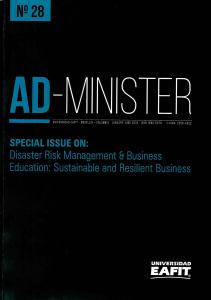
Disaster risk management in business education setting the tone
DOI:
https://doi.org/10.17230/ad-minister.28.1Keywords:
business continuity, business education, business ethics, business value, disaster risk, disaster risk metrics, financial decisions, risk transfer, SMEs, social responsibility, strategic investmentAbstract
Looking for windows of opportunity to mainstream disaster risk management within business education, in 2015, the United Nations Office for Disaster Reduction’s (UNISDR) Private Alliance for Disaster Resilient Societies (arise), partnered with Florida International University’s Extreme Events Institute (FIU-EEI) and 12 international leading business schools. This partnership began with a call for White Papers to propose innovative approaches to integrate cutting edge disaster management content into business education programs and other academic offerings, based on seven themes or niches identified: (1) Strategic Investment and Financial Decisions; (2) Generating Business Value; (3) Sustainable Management; (4) Business Ethics and Social Responsibility; (5) Business Continuity Planning; (6) Disaster Risk Metrics; and (7) Risk Transfer. In March 2016, an international workshop was held in Toronto, Canada to present the White Papers prepared by the business schools, and discuss the most appropriate approaches for addressing the areas of: teaching and curriculum; professional development and extension programs; internships and placement; research opportunities; and partnerships and collaboration. Finally, the group proposed goals for advancing the implementation phase of the business education initiatives, and to propose mechanisms for monitoring and follow-up.Downloads
Published
Issue
Section
License
Authors who publish with this journal agree to the following terms:
a. Authors retain copyright and grant the journal right of first publication with the work simultaneously licensed under aCreative Commons Attribution License that allows others to share the work with an acknowledgement of the work's authorship and initial publication in this journal.
b. Authors are able to enter into separate, additional contractual arrangements for the non-exclusive distribution of the journal's published version of the work (e.g., post it to an institutional repository or publish it in a book), with an acknowledgement of its initial publication in this journal.
c. Authors are permitted and encouraged to post their work online (e.g., in institutional repositories or on their website) prior to and during the submission process, as it can lead to productive exchanges, as well as earlier and greater citation of published work (See The Effect of Open Access).

