
Tulio Restrepo: Campo Abierto / Espacio en tránsito
DOI:
https://doi.org/10.17230/co-herencia.16.30.15Keywords:
Colombian art, contemporary art, image, urban space, dystopiaAbstract
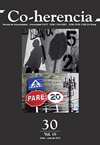
The work of the artist Tulio Restrepo (Medellín, 1958), shares a trait with local artistic production which has been present since at least the 1970s: the attempt to form an image of the city and the urban in a rapidly changing context, which is hazardous and propitiates anonymity. This paper reviews the series Campo Abierto / Espacio en tránsito (Open field/space in transit), included in this issue of Co-herencia, a set of 20 digitally produced images where subjects about the anonymous condition of pedestrians in the urban space, surveillance and security, visual codes or the fragility of experiences for those who get around the city coexist. To do this, this paper discusses some theories about urbanism in the 1960s and examines the context
in which the artistic production of Tulio Restrepo is produced.
References
Citámbulos. (2006). Citámbulos, el transcurrir de lo insólito. Guía de asombros de Ciudad de México. Ciudad de México: conaculta, fonca.
Delgado, M. (2011). Prólogo. En: J. Jacobs, Muerte y vida de las grandes ciudades (pp. 15-23). Navarra: Capitán Swing.
Harvey, D. (2013). Ciudades rebeldes. Del derecho de la ciudad a la revolución urbana. Madrid:
Akal.
Jacobs, J. (2011). Muerte y vida de las grandes ciudades. Navarra: Capitán Swing.
Lefebvre, H. (2013). La producción del espacio. Madrid: Capitán Swing.
Lynch, K. (2008). La imagen de la ciudad. Barcelona: Gustavo Gili.
Mumford, L. (2014). La ciudad en la historia. Orígenes, transformaciones y perspectivas. La Rioja: Pepitas de calabaza.
Restrepo, T. (2016). Reseña de la obra Campo Abierto / Espacio en tránsito. En: Retrospective, 10 Years MAG3 (pp. 42-43). Vienna: Project room MAG3.
Sassen, S. (2010). Territorio, autoridad y derechos. De los ensamblajes medievales a los ensamblajes globales. Buenos Aires: Katz.
Downloads
Published
Issue
Section
License
Copyright (c) 2019 Co-herencia

This work is licensed under a Creative Commons Attribution 4.0 International License.
Attribution 4.0 International (CC BY 4.0)
You are free to:
- Share — copy and redistribute the material in any medium or format
- Adapt — remix, transform, and build upon the material for any purpose, even commercially.
The licensor cannot revoke these freedoms as long as you follow the license terms.
Under the following terms:
-
Attribution — You must give appropriate credit, provide a link to the license, and indicate if changes were made. You may do so in any reasonable manner, but not in any way that suggests the licensor endorses you or your use.
- No additional restrictions — You may not apply legal terms or technological measures that legally restrict others from doing anything the license permits.
Avisos:
- No tiene que cumplir con la licencia para elementos del material de dominio público o cuando su uso esté permitido por una excepción o limitación aplicable .
- No se dan garantías. Es posible que la licencia no le otorgue todos los permisos necesarios para el uso previsto. Por ejemplo, otros derechos como la publicidad, la privacidad o los derechos morales pueden limitar la forma en que utiliza el material.


 Revista de la Escuela de Artes y Humanidades, Universidad EAFIT.


