
Methodology for Landslide Susceptibility Assessment Along Linear Projects
Study Case in the Water Supply Pipeline of Fredonia, Antioquia
DOI:
https://doi.org/10.17230/ingciencia.13.26.7Keywords:
Linear projects, SHALSTAB, conditional analysis, heuristic, TOBIA index, susceptibility, hazardAbstract
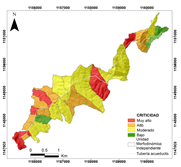
Landslides are characterized by their capacity to generate losses. In Colombia, a considerable percentage of those are associated with linear projects; between 2010-2011, 575 municipalities were affected by damage to the infrastructure of water supply network and sanitation. Considering this serious problem related to linear projects, the present work proposes the combination of heuristic, statistical and physical based methods to evaluate the susceptibility and hazard of landslides, under different scales of analysis. In addition to the construction of a critical unit map, using as the unit of analysis the Independent Morphodynamic Unit. The obtained model is validated using the success curves and the Area Under the Curve (AUC). The proposed methodology was implemented in the pipeline of the municipal aqueduct of the municipality of Fredonia in the Antioquia region. It was identified 6% of areas, both unstable and very high and high susceptibility; and 13% of areas corresponding to both cataclinal over dip and pure dip slope, as well as areas of very high and high susceptibility. The AUC for the conditional analysis and the criticality map showed a value of 0.81 and 0.73 indicating a very good fit and performance of the models.
Downloads
Downloads
Published
Issue
Section
License
Authors who publish with this journal agree to the following terms:
- Authors retain copyright and grant the journal right of first publication with the work simultaneously licensed under a Creative Commons Attribution License that allows others to share the work with an acknowledgement of the work's authorship and initial publication in this journal.
- Authors are able to enter into separate, additional contractual arrangements for the non-exclusive distribution of the journal's published version of the work (e.g., post it to an institutional repository or publish it in a book), with an acknowledgement of its initial publication in this journal.
- Authors are permitted and encouraged to post their work online (e.g., in institutional repositories or on their website) prior to and during the submission process, as it can lead to productive exchanges, as well as earlier and greater citation of published work (See The Effect of Open Access).


 Plagiarism Detection
