
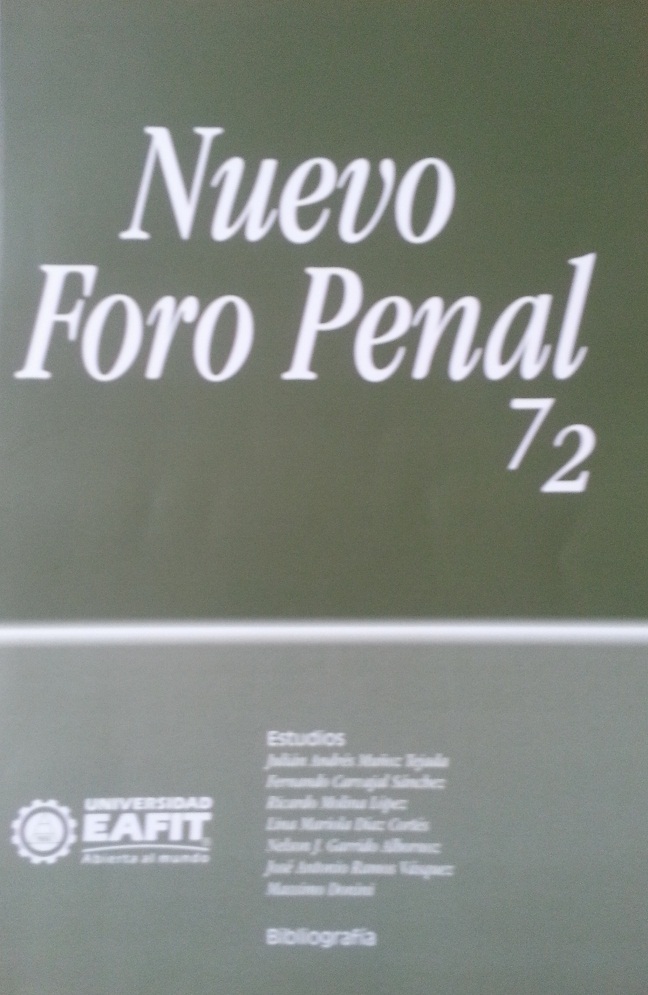
El ciudadano extracomunitario: de “objeto material” a “tipo de autor” en el control penal de la inmigración
Keywords:
Extranjero extracomunitario, Tipo de autor, Derechos fundamentales, Derechos de ciudadanía, Extranjero como objeto material de la Ley penal, Derecho penal del enemigo, Estado de prevenciónAbstract
The most important problem addressed by Professor Masimo Donini in this article, is to determine the extent to which the distinction between foreigners belonging to the community and the ones who don´t -within the European Community of Nations- implies serious discriminations to the rights of all accused of a crime should have. Given that foreigners are referred only as perpetrators of crimes or as “material” objects of behaviors of others and of disciplines of regulation of migration flows, it seems plausible to assert that equality has experienced a national inclination, a nationalist differentiation constitutionally admissible according to which foreigners do not have a legal and social treatment “equivalent” to that of citizens. Accordingly, the criminal law based in facts has been pushed, adopting instead a criminal law of the excluded: the illegal foreign not belonging to the community is therefore a person to exclude, an “enemy” in the sense that the instrument of punishment is used against him only to exclude him.Downloads
Downloads
Published
Issue
Section
License
Authors who publish with this journal agree to the following terms:
- Authors retain copyright and grant the journal right of first publication with the work simultaneously licensed under aCreative Commons Attribution License that allows others to share the work with an acknowledgement of the work's authorship and initial publication in this journal.
- Authors are able to enter into separate, additional contractual arrangements for the non-exclusive distribution of the journal's published version of the work (e.g., post it to an institutional repository or publish it in a book), with an acknowledgement of its initial publication in this journal.
- Authors are permitted and encouraged to post their work online (e.g., in institutional repositories or on their website) prior to and during the submission process, as it can lead to productive exchanges, as well as earlier and greater citation of published work (See The Effect of Open Access).

