
Estimativos de error para un método de Galerkin libre de mallas en múltiples dimensiones con derivadas difusas y estabilización
DOI:
https://doi.org/10.17230/ingciecia.9.17.3Palabras clave:
Método libre de mallas, derivadas difusas, mínimos cuadrados en movimiento, método de elementos difusos, estimativos de error.Resumen
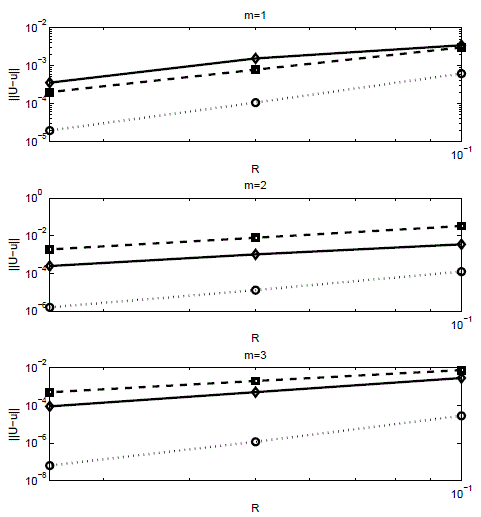
Se presenta un método libre de mallas con derivadas difusas y estabilización por penalización. Un análisis de error para la aproximación de la solución de una ecuación elíptica general en múltiples dimensiones, con condiciones de frontera tipo Neumann es desarrollado. Resultados numéricos y teóricos muestran que el error de aproximación y la velocidad de convergencia son mejores que en el método de elementos difusos.
MSC: 65N12, 65N15, 65N30
Descargas
Referencias
T. Belytschko, Y. Krongauz, M. Fleming, D. Organ, and W. K. Liu, “Smoothing and accelerated computations in the element free Galerkin method,” J. Comput. Appl. Math, vol. 74, pp. 111–126, 1996. 54
P. Breitkopf, A. Rassineux, G. Touzot, and P. Villon, “Explicit form and efficient computations of MLS shape functions and their derivatives,” Int. J. Numer. Meth. Engrg., vol. 48, pp. 451–466, 2000. 54
B. Nayroles, G. Touzot, and O. Villon, “Generating the finite element method: diffuse approximation and diffuse elements,” Comput. Mech., vol. 10, pp. 307–318, 1992. 54, 61
T. Belytschko, Y. Y. Lu, and L. Gu, “Element-free Galerkin methods,” Int. J. Numer. Methods Engrg., vol. 37, pp. 229–256, 1994. 54
Y. Krongauz and T. Belytschko, “A Petrov-Galerkin diffuse element method (PG DEM) and its comparison to EFG,” Computational Mechanics, vol. 19, pp. 327–333, 1997. 54
A. Huerta, Y. Vidal, and P. Villon, “Pseudo-divergence-free element free Galerkin method for incompressible fluid flow,” Comput. Methods Appl. Mech. Engrg., vol. 193, pp. 1119–1136, 2004. 54, 57, 74
I. Babuska, U. Banerjee, and J. Osborn, “Survey of meshless and generalized finite element methods: A unified approach,” Acta Numerica, pp. 1–125, 2003. 55
W. Han and X. Meng, “Error analysis of the reproducing kernel particle method,” Comput. Methods Appl. Mech. Engrg., vol. 190, pp. 6157–6181, 2001. 55, 60
M. Armentano, “Error estimates in Sobolev spaces for moving least square approximations,” SIAM J. Numer. Anal., vol. 39, pp. 38–51, 2001. 55, 60, 62, 66
D. W. Kim and W. K. Liu, “Maximum principle and convergence analysis for the meshfree point collocation method,” SIAM J. Numer. Anal., vol. 44, pp.515–539, 2006. 55
D. A. French and M. Osorio, “A Galerkin Meshfree Method with Diffuse Derivatives and Stabilization,” Computational Mechanics., vol. 50, pp. 657–664, 2012. 55, 62, 65, 68, 73
O. C. Zienkiewicz, “Constrained variational principles and penalty function methods in the finite element analysis,” Lecture Notes in Mathematics, vol. 363, pp. 207–214, 1974. 55
T. Hughes, L. Franca, and G. Hulbert, “A new finite element formulation for computational fluid dynamics: VIII. The Galerkin/least-squares method for advective-diffusive equations,” Comput. Methods Appl. Mech. Engrg., vol. 73, pp. 173–189, 1989. 55
S. Beissel and T. Belytschko, “Nodal integration of the element-free Galerkin method,” Comput. Methods Appl. Mech. Engrg., vol. 139, pp. 49–74, 1996. 55
M. Osorio, “Error analysis of a Meshfree method with diffuse derivatives and penalty stabilization,” Ph.D. dissertation, University of Cincinnati, 2010. 58, 60, 65, 66, 74
M. Armentano and R. Duran, “Error estimates for moving least square approximations,” Applied Numerical Mathematics, vol. 37, pp. 397–416, 2001. 60
W. K. Liu and T. Belytschko, “Moving least-square reproducing kernel methods. Part I: Methodology and convergence,” Comput. Methods Appl. Mech. Engrg., vol. 143, pp. 113–154, 1997. 60
D. Kim and Y. Kim, “Point collocation methods using the fast moving least square reproducing kernel approximation,” Int. J. Numer. Meth. Engrg., vol. 56, pp. 1445–1464, 2003. 61
P. Breitkopf, A. Rassineux, and P. Villon, An introduction to moving least squares meshfree methods. In: Meshfree and particle based approaches in computational mechanics. Edited by P. Breitkopf and A. Huerta, 2004. 73
Descargas
Publicado
Número
Sección
Licencia
Los autores que publican en esta revista están de acuerdo con los siguientes términos:
- Los autores conservan los derechos de autor y garantizan a la revista el derecho de ser la primera publicación del trabajo al igual que licenciado bajo una Creative Commons Attribution License que permite a otros compartir el trabajo con un reconocimiento de la autoría del trabajo y la publicación inicial en esta revista.
- Los autores pueden establecer por separado acuerdos adicionales para la distribución no exclusiva de la versión de la obra publicada en la revista (por ejemplo, situarlo en un repositorio institucional o publicarlo en un libro), con un reconocimiento de su publicación inicial en esta revista.
- Se permite y se anima a los autores a difundir sus trabajos electrónicamente (por ejemplo, en repositorios institucionales o en su propio sitio web) antes y durante el proceso de envío, ya que puede dar lugar a intercambios productivos, así como a una citación más temprana y mayor de los trabajos publicados (Véase The Effect of Open Access) (en inglés).


 Plagiarism Detection
