
Error estimates for a multidimensional meshfree Galerkin method with diffuse derivatives and stabilization
DOI:
https://doi.org/10.17230/ingciecia.9.17.3Keywords:
Meshfree methods, diffuse derivatives, moving least squares, diffuse element method and error estimates.Abstract
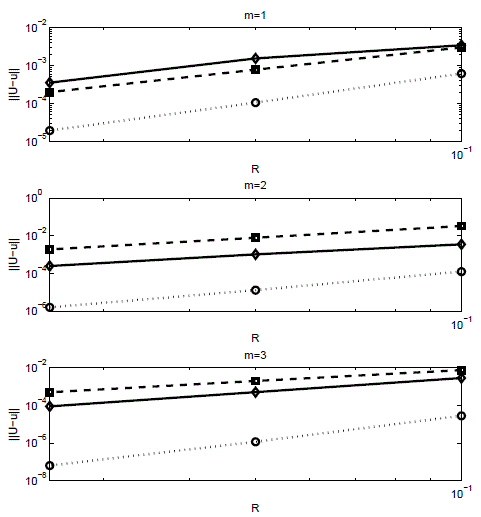
A meshfree method with diffuse derivatives and a penalty stabilization is developed. An error analysis for the approximation of the solution of a general elliptic differential equation, in several dimensions, with Neumann boundary conditions is provided. Theoretical and numerical results show that the approximation error and the convergence rate are better than the diffuse element method.
MSC: 65N12, 65N15, 65N30
Downloads
References
T. Belytschko, Y. Krongauz, M. Fleming, D. Organ, and W. K. Liu, “Smoothing and accelerated computations in the element free Galerkin method,” J. Comput. Appl. Math, vol. 74, pp. 111–126, 1996. 54
P. Breitkopf, A. Rassineux, G. Touzot, and P. Villon, “Explicit form and efficient computations of MLS shape functions and their derivatives,” Int. J. Numer. Meth. Engrg., vol. 48, pp. 451–466, 2000. 54
B. Nayroles, G. Touzot, and O. Villon, “Generating the finite element method: diffuse approximation and diffuse elements,” Comput. Mech., vol. 10, pp. 307–318, 1992. 54, 61
T. Belytschko, Y. Y. Lu, and L. Gu, “Element-free Galerkin methods,” Int. J. Numer. Methods Engrg., vol. 37, pp. 229–256, 1994. 54
Y. Krongauz and T. Belytschko, “A Petrov-Galerkin diffuse element method (PG DEM) and its comparison to EFG,” Computational Mechanics, vol. 19, pp. 327–333, 1997. 54
A. Huerta, Y. Vidal, and P. Villon, “Pseudo-divergence-free element free Galerkin method for incompressible fluid flow,” Comput. Methods Appl. Mech. Engrg., vol. 193, pp. 1119–1136, 2004. 54, 57, 74
I. Babuska, U. Banerjee, and J. Osborn, “Survey of meshless and generalized finite element methods: A unified approach,” Acta Numerica, pp. 1–125, 2003. 55
W. Han and X. Meng, “Error analysis of the reproducing kernel particle method,” Comput. Methods Appl. Mech. Engrg., vol. 190, pp. 6157–6181, 2001. 55, 60
M. Armentano, “Error estimates in Sobolev spaces for moving least square approximations,” SIAM J. Numer. Anal., vol. 39, pp. 38–51, 2001. 55, 60, 62, 66
D. W. Kim and W. K. Liu, “Maximum principle and convergence analysis for the meshfree point collocation method,” SIAM J. Numer. Anal., vol. 44, pp.515–539, 2006. 55
D. A. French and M. Osorio, “A Galerkin Meshfree Method with Diffuse Derivatives and Stabilization,” Computational Mechanics., vol. 50, pp. 657–664, 2012. 55, 62, 65, 68, 73
O. C. Zienkiewicz, “Constrained variational principles and penalty function methods in the finite element analysis,” Lecture Notes in Mathematics, vol. 363, pp. 207–214, 1974. 55
T. Hughes, L. Franca, and G. Hulbert, “A new finite element formulation for computational fluid dynamics: VIII. The Galerkin/least-squares method for advective-diffusive equations,” Comput. Methods Appl. Mech. Engrg., vol. 73, pp. 173–189, 1989. 55
S. Beissel and T. Belytschko, “Nodal integration of the element-free Galerkin method,” Comput. Methods Appl. Mech. Engrg., vol. 139, pp. 49–74, 1996. 55
M. Osorio, “Error analysis of a Meshfree method with diffuse derivatives and penalty stabilization,” Ph.D. dissertation, University of Cincinnati, 2010. 58, 60, 65, 66, 74
M. Armentano and R. Duran, “Error estimates for moving least square approximations,” Applied Numerical Mathematics, vol. 37, pp. 397–416, 2001. 60
W. K. Liu and T. Belytschko, “Moving least-square reproducing kernel methods. Part I: Methodology and convergence,” Comput. Methods Appl. Mech. Engrg., vol. 143, pp. 113–154, 1997. 60
D. Kim and Y. Kim, “Point collocation methods using the fast moving least square reproducing kernel approximation,” Int. J. Numer. Meth. Engrg., vol. 56, pp. 1445–1464, 2003. 61
P. Breitkopf, A. Rassineux, and P. Villon, An introduction to moving least squares meshfree methods. In: Meshfree and particle based approaches in computational mechanics. Edited by P. Breitkopf and A. Huerta, 2004. 73
Downloads
Published
Issue
Section
License
Authors who publish with this journal agree to the following terms:
- Authors retain copyright and grant the journal right of first publication with the work simultaneously licensed under a Creative Commons Attribution License that allows others to share the work with an acknowledgement of the work's authorship and initial publication in this journal.
- Authors are able to enter into separate, additional contractual arrangements for the non-exclusive distribution of the journal's published version of the work (e.g., post it to an institutional repository or publish it in a book), with an acknowledgement of its initial publication in this journal.
- Authors are permitted and encouraged to post their work online (e.g., in institutional repositories or on their website) prior to and during the submission process, as it can lead to productive exchanges, as well as earlier and greater citation of published work (See The Effect of Open Access).


 Plagiarism Detection
